Welcome to 2025 PICTURE BOOK CLUB – WEEK FOUR
How to participate in 2025 Picture Book Club …
-
Get the suggested books from your library or bookstore (local or online). See PICTURE BOOK CLUB BOOK LIST for the complete list of books for each week.
-
Before reading each of the weekly books to your child, READ FIRST “What Adults Can Learn from This Story.”
-
Read one or both books to your child as many times through the week as your child wants to hear them and you have time to read.
-
Consider doing whatever activities you think are appropriate for the age and maturity of your child from “Make This Story Come Alive for Your Child.”
WE WELCOME FEEDBACK ABOUT YOUR PARTICIPATION. YOU CAN LEAVE A COMMENT BY USING THE “WHAT DO YOU THINK?” BUTTON AT THE BOTTOM OF THIS POST.
I WILL LOVE YOU NO MATTER WHAT by J. Rutland
(a story about unconditional love)

Little Blue bluebird is thinking he should run away from home because he doesn’t follow the rules and gets in trouble. He figures his daddy is fed up with him and won’t want him around anymore. To convince Little Blue this isn’t true Daddy Blue tells him the story of Prince Chirpio, who also got in trouble seeking adventure and excitement. Prince Chirpio went off one day. His daddy was very worried about him and never stopped searching or loving him. Chirpio eventually wanted to go home but was afraid his daddy would not want him home. But, his daddy, King Puffbelly, welcomed him with open wings proving that he would always love Chirpio no matter what. Chirpio’s story taught Baby Blue that his daddy would also love him no matter what – “On fun days and sad days and happy days and mad days….”
What Adults Can Learn from This Story
-
Love has two parts. One part means caring for and caring about your children just because they are who they are. They don’t have to be good at doing things or at following rules to earn this part of your love. They deserve it just because they came into this world.
-
The other part of love is about teaching your children to be independent and capable of taking care of themselves. This is the part they earn every time they learn skills, follow rules, or pay consequences for not following rules. They make mistakes along the way but deserve to be patiently taught and have adults stick with them always expecting them to be successful in the end.
-
Loving no matter what does not mean excusing or ignoring bad behavior. Adults can love their children but not love their behavior. They can love their children regardless of their behavior while still firmly correcting their bad behavior and teaching them good behavior. This is balanced love.
-
Sometimes adults think if they want their children to feel loved they cannot expect too much of them. They think they need to save them from the hard things in life like learning in school, doing chores, and following rules. But loving children no matter what can help them do hard things and learn from making mistakes. That is what gives them the inner strength to do what they are supposed to do. Some people call this having “grit” – the ability to deal with hard things and stay on the right path toward doing what they should. Without love they can depend on no matter what, the right things are so much harder to do.
-
Children try harder and are more motivated when they know love doesn’t turn on and off based on how well they can do things or on whether they do the right things.
-
Love no matter what helps children believe they can do things as many times as they need to be good at them. That they can learn one step at a time. That they don’t have to be perfect the first time or every time they try something. That it is OK to make mistakes and get up, brush themselves off, and try again.
-
Children naturally want to make up for things they do wrong and get back into good graces when they mess up. It is important that adults give children a chance to make up for mistakes and teach them how to go about doing that. Doing something to make amends is so much better than just saying you are sorry. If children hurt someone, they can get ice or a bandage for the injury or offer to play the person’s favorite game to make him feel better. If they break something, they can help fix it, pay to have it fixed, or offer the owner something nice to substitute for it. Making amends even when the incident is an accident can repair children’s views of themselves at the same time it is making a victim feel better. It teaches children that they deserve to be loved and can be loved even when they make mistakes.
Make this Story Come Alive for Your Child
-
Offer your child 3 messages through the day that are about who he is. “You are so fun to be with.” Give a hug. Invite him to do something special with you (a game, bake cookies, go get ice cream).
-
Compliment your child through the day about 3 things he did well. “Thank you for helping me carry the groceries in.” “You hit the baseball the farthest ever today. Awesome!” “I felt very proud when I saw how you followed the rule about staying in the yard.” “Congratulations, you got a B+ on your test. Tell me how you did that.”
-
Share a time that you made amends when you hurt someone, even if the incident was an accident.
-
Ask your child if he remembers a time when he hurt someone, even if it wasn’t on purpose. Talk about how he made up for that at the time or brainstorm with him now how he could have made up for it. Ask him how he thinks the person felt or would feel if he made amends.
-
Share a time when you learned how after making a mistake you were able to learn how to do something better.
-
Ask your child if she remembers making a mistake and because of the mistake was able to figure out a better way to do something.
MORRIS THE ARTIST by Lore Segal
(a story about creativity)
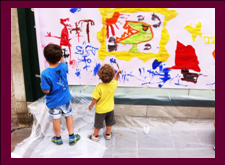
In MORRIS THE ARTIST a young boy is uncooperative about going to a friend’s birthday party because he just wants to stay home and paint. He wanted to be an artist. His mother insisted he go with her to buy a present and attend the birthday party. Morris selected the present he wanted, not one his mother suggested. When it came time for Morris to give his present, he wouldn’t let go for anything. When he finally was willing to give the present, no one was interested, so he opened it himself and began to show everybody what could be done with his present and all the guests had the most colorful birthday celebration ever.
What Adults Can Learn from This Story
-
Children can be very excited about art. It is ever so important in a child’s growth and development. Children need a chance to do art at home and in their schools, hopefully in many forms (drawing, painting, sculpting, music, dance, acting, etc.).
-
When children do art, they must think for themselves. One stroke a picture doesn’t make. One note a song doesn’t make. Art requires decision after decision. When children make choices in art and all other aspects of their lives, they are learning to know what their likes and dislikes are and trust their inner voices.
-
Art takes time to unfold. Children must stick with it and persevere. If they don’t, they won’t get the satisfaction of seeing their final product.
-
When children do art, they must focus. It takes attention and concentration to get ideas from their heads through their muscles and nerves and onto a page or stage. Art can help children become good problem solvers. Art is a problem by definition – how to change raw material like paint, clay, or the sound of an instrument into something completely different and new.
-
Children need a lot of freedom when doing art. It’s important to let them decide what to draw and how it should look.
-
Children can be taught to “stay in the lines” to learn to use their small muscles and tell the difference between one line and another and one shape and another, but this is not art as an expression of self. That type of activity requires the freedom to create both in and out of lines.
-
Art is usually messy. It makes doing art a great opportunity for chores or rules. Children can learn to clean up after themselves and learn exactly what the steps are to a good cleanup job.
-
When going shopping with children adults need to prepare ahead of time. Shopping for what, where, at what price, and who decides.
-
Adults need to know what they will do, if things don’t go well when shopping with their children. Especially preschool age children can have major melt downs or temper tantrums, if the choices get to be too much for them or if the buying means they don’t get what they want for themselves. Plan the trip for several days ahead of when the purchase is needed, so if the trip goes badly and must be abandoned there will still be time for a Plan B.
-
Think ahead about and plan for what could go wrong on a shopping trip with children. Too many choices involved? Too many stores? Hungry or sleepy children? Making sure children have slept and eaten before shopping is a must.
-
Learning to shop is a needed life lesson, but sometimes it is best for adults to shop on their own. Some adults bring home a couple of choices so children can make a decision in the comfort of their own home. The adult then returns the “un-chosen” at a later time.
Make This Story Come Alive for Your Child
-
Do an art project and teach your child how to help with the clean up afterwards. Make a clean-up chart that includes a place where the different tasks can be checked off as completed and a place where the quality of the work can be noted. Explain to your child what the steps are to completing each task and how he will know if it is well done. He can learn what it means to not only have a job to do but also how to do it well. So, in the end, all the mess is worth it.
-
Do an art project focusing on your child making choices. Let her decide what type of art (painting, drawing, sculpting. singing. dancing. etc.). As she works on her art ask her why she chose a certain color or why she chose the subject(s) of the art.
-
Read with your child about the sciences of art – what makes paint different colors, what is play dough made of, etc.
-
Explore the keyboard of a piano or the strings of a violin or guitar with your child. Or explore an instrument he may never have heard of or seen before.
-
Plan a shopping trip with your child. Together, plan what you are shopping for, what store(s) you will go to, how much you will spend, and who is making the final decision about a purchase.Will your child decide all on his own or will he need your final approval? Or will you do the first selection of two or three things and let him make the final decision?
Be sure he is rested and has been fed before you go.

